

Every year, millions of tonnes of food are grown, tended to, and harvested across the African continent — only to never reach a plate. Postharvest loss Africa is one of the most devastating yet least discussed contributors to hunger and economic instability on the continent. From smallholder farms in rural Nigeria to commercial operations in Kenya’s Rift Valley, the story is painfully consistent: food grown with enormous effort and expenditure disappears somewhere between the field and the consumer. This is not merely a logistics problem. It is a food security crisis unfolding in slow motion, and it demands urgent, coordinated attention.
The Scale of Postharvest Loss Africa: What the Numbers Tell Us
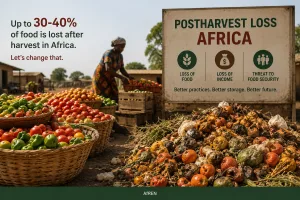
The numbers are staggering. According to the Food and Agriculture Organization (FAO), roughly one-third of all food produced globally is lost or wasted — and Sub-Saharan Africa accounts for a disproportionately large share of that figure. Estimates suggest that postharvest food losses across Africa amount to approximately 120 million tonnes annually, with a value exceeding $4 billion USD. In some crops and regions, loss rates exceed 40 to 50 percent of total production.
For a continent where over 280 million people are classified as chronically undernourished, the irony is brutal. African food systems are producing enough to make a significant dent in hunger, yet structural, infrastructural, and systemic failures ensure that a massive proportion of that food is squandered before it can do any good. Cereals, legumes, fruits, vegetables, and fish are all affected — no commodity category is spared.
What makes postharvest loss Africa particularly painful is that it strikes hardest at smallholder farmers — the backbone of the continent’s agricultural economy. These farmers, many of whom operate on less than two hectares of land, lose income, food, and dignity every season when their produce spoils or fetches dismal prices because markets are flooded with goods that cannot be stored.
Why Postharvest Food Losses Persist: Root Causes Across the Value Chain
Understanding why postharvest food losses remain so severe requires a clear-eyed look at the multiple failure points that exist across African agricultural value chains. These are not isolated problems. They are interconnected, mutually reinforcing, and deeply embedded in how African food systems have historically been structured and funded.
Inadequate Storage Infrastructure
Perhaps the most visible driver of postharvest loss across Africa is the near-total absence of adequate, affordable storage. In much of rural Sub-Saharan Africa, cold chain infrastructure is essentially non-existent. Perishable produce — tomatoes, leafy greens, mangoes, fish — can spoil within 24 to 48 hours of harvest in tropical temperatures, particularly without refrigeration. Even for dry commodities like maize or sorghum, traditional storage structures offer limited protection against pests, moisture, and fungal contamination. Hermetically sealed bags and metal silos exist, but awareness, access, and affordability remain significant barriers for most smallholder farmers.
Poor Road Networks and Transportation Failures
Even when food is properly harvested, getting it to market quickly and intact is a major challenge. Poor road infrastructure in rural Africa means that journeys that should take hours can stretch into days. Produce jolted along potholed roads in unsealed trucks sustains physical damage that accelerates spoilage. In landlocked regions or areas isolated during rainy seasons, entire harvests can become commercially unviable before they reach the nearest urban market.
Limited Access to Processing and Value Addition
In high-income countries, a significant portion of agricultural produce that would otherwise go to waste is redirected into processed goods — canned vegetables, dried fruit, flour, juices, and preserved foods. African food systems largely lack this buffer. Processing capacity across Sub-Saharan Africa remains severely underdeveloped, meaning that gluts at harvest time translate directly into waste rather than opportunity. A mango surplus becomes rotting fruit rather than mango pulp or dried snacks. This gap in value-addition infrastructure is both a cause of postharvest loss and a missed economic opportunity at a massive scale.
Knowledge Gaps and Harvesting Practices
Postharvest loss in Africa also has a significant knowledge dimension. Improper harvesting techniques, premature picking, rough handling, and poor post-harvest hygiene all contribute to loss. Extension services that train farmers on best practices are chronically underfunded across much of the continent, leaving generations of farmers dependent on traditional methods that, while culturally important, are not optimized to reduce loss in today’s production volumes and market demands.
The Connection Between Postharvest Loss and Food Security in Africa
The relationship between postharvest food losses and food security in Africa is direct, measurable, and devastating. Every kilogram of food that is lost after harvest is a kilogram that cannot feed a hungry family, generate income for a farming household, or contribute to national nutrition targets. If Africa were able to halve its postharvest losses, the additional food made available would dwarf the volumes currently delivered through food aid programs. The math is simple even if the solution is not.
Food security in Africa is typically framed around production — how do we grow more food? But this framing is dangerously incomplete. A continent that loses nearly half of its fruits and vegetables before they reach consumers does not primarily have a production problem. It has a postharvest problem. Investing in storage, processing, roads, and knowledge transfer is, calorie for calorie, arguably a more efficient pathway to food security than expanding farmland or increasing planting.
There is also a gender dimension that is frequently overlooked. Women make up the majority of smallholder farmers across Sub-Saharan Africa and bear a disproportionate burden of postharvest handling, processing, and marketing. When food is lost, it is women who absorb much of the economic shock — through reduced income, increased domestic food insecurity, and diminished bargaining power within households. Any strategy to address food security in Africa must therefore specifically empower women in postharvest management.
What Solutions Look Like: Rebuilding African Food Systems from the Farm Gate
Tackling postharvest loss in Africa requires systemic, multi-actor intervention — not a single technology or policy silver bullet. However, successful models do exist, and they provide a compelling roadmap for what scaled-up action could look like.
Affordable and Appropriate Storage Technologies
Hermetically sealed storage bags, such as the PICS (Purdue Improved Crop Storage) bag, have demonstrated significant reductions in grain loss across West Africa with minimal investment. Solar-powered cold rooms are gaining traction as costs decline, with pilot projects in Ghana, Nigeria, and Ethiopia showing strong results for perishable produce. The challenge is scaling adoption, which requires subsidy programs, rural finance, and awareness campaigns working in tandem.
Strengthening Market Linkages and Digital Tools
Mobile technology is reshaping African food systems in meaningful ways. Platforms that connect farmers directly to buyers — bypassing long middlemen chains — reduce the time produce spends in transit and give farmers better price information, reducing the likelihood of distress sales. Apps that provide real-time market pricing, weather data, and transport coordination are already operational in markets like Nigeria, Kenya, and Tanzania. Scaling these solutions and ensuring internet access in rural areas is a prerequisite for their wider impact.
Investment in Rural Roads and Cold Chain Infrastructure
Long-term reduction of postharvest food losses across African food systems demands sustained public investment in rural infrastructure. Road connectivity, reliable electricity, and cold chain networks are not luxuries — they are the foundational prerequisites for a functional agricultural economy. Governments and development finance institutions must treat these investments as core food security expenditure, not peripheral development spending.
Policy Reform and Private Sector Engagement
African governments can drive significant change through targeted policy reforms: tax incentives for cold storage construction, subsidized crop insurance that reduces farmer risk, and standards enforcement that raises the bar for handling and transportation. Equally important is catalyzing private sector investment. Agribusinesses, processors, and retailers all have economic incentives to reduce loss in their supply chains — but they often need regulatory clarity and infrastructure support to act on those incentives.
Conclusion: Ending the Silent Crisis of Postharvest Loss in Africa
Postharvest loss in Africa is not an inevitable feature of African agriculture. It is a solvable problem — one that requires political will, targeted investment, and a fundamental shift in how African food systems are designed, resourced, and valued. The continent is not short of food potential. It is short of the infrastructure, technology, and policy frameworks needed to protect that potential from field to fork.
Every tonne of food saved from postharvest loss is a tonne that improves food security in Africa without requiring a single additional seed to be planted. Every dollar invested in storage, roads, processing, and farmer education returns multiples in retained produce value, farmer income, and national food availability. The silent crisis of postharvest food losses has been documented, analyzed, and lamented for decades. What Africa needs now is action — coordinated, adequately funded, and sustained across political cycles.
If the goal is genuine food security across Africa, then reducing postharvest loss Africa must sit at the center of the strategy — not at its margins. The food is being grown. The question is whether African food systems can finally be built to protect it.

afrennetwork